

“Reddish Doesn’t Always Mean Rust: Correct Understanding of Construction Rebar Quality in Bangladesh”
In Bangladesh, infrastructure development is rapidly increasing, and with it, the demand and production of construction Rebars or rebars are also growing quickly. Along with this increasing demand, there has been a misconception regarding the color change of the Rebars. Many people believe that if a Rebar turns red or brown, it has rusted and is of poor quality. However, this is a completely false notion. Does the quality of the Rebars change? Let’s find out in detail.
Increasing Demand for Construction Rebars in Bangladesh
Due to infrastructure development in Bangladesh, the demand for construction Rebars is constantly rising. The country has a production capacity of about 8.7 million metric tons of construction Rebars per year, while the demand is approximately 5.5 million to 6 million metric tons. To meet this demand, 35 large and small companies in Bangladesh are working, and this demand is increasing every year.

Why Do Construction Rebars Turn Reddish or Brown?
Generally, the color of construction Rebars or rebars is dark. However, some rods may turn Reddish or brown. Upon seeing this, many people assume that the Rebar has rusted. But this is entirely a misconception.
How Does Rust Form?
Rust or corrosion occurs when iron comes into contact with the oxygen in the air and water. Chemically, this results in the formation of ferric oxide (Fe(OH)₃). The moment iron is produced, it immediately comes into contact with oxygen in the air. Additionally, various environmental factors like rain, humidity, or water on the construction site can lead to the Rebar coming into contact with water.
Do you think this will affect the quality of the Rebar?
The answer is mostly “no,” unless you continuously immerse the Rebar in water for months or keep it under a constant stream of water, which none of us do.
The quality of the Rebar depends on three factors:
- Correct Diameter: The size of the Rebar must be precise to provide the necessary strength to the structure.
- Correct Chemical Composition: The chemical components of the iron, such as carbon, manganese, etc., must be properly mixed.
- Microstructure: The correct ratio of the outer and inner layers of the Rebar must be ensured.
Initially, the reddish or brownish color that appears on the Rebar is just the early stage of rust. As a result, you will never feel any powdery residue on the Rebar’s surface. This means the Rebar hasn’t suffered any corrosion, and its diameter hasn’t changed by even a fraction. Also, there’s no significant chemical change. Therefore, the quality of your Rebar remains unaffected. We should not have any doubts about rods that have turned reddish or brown.
Whether you call it rust, corrosion, or oxidation, many international organizations have provided guidelines on these issues.
According to the American Concrete Institute (ACI) 301 (2005):
“When concrete is placed, all reinforcements must be free from harmful materials to ensure proper bonding.”
According to ACI 318 (2008):
“Reinforcing steel is considered satisfactory if it has rust, mill scale, or a combination of both, as long as the minimum size/height of deformation is maintained and a hand wire-brush test meets the applicable ASTM specifications.”
According to the American Association of State Highway and Transportation Officials (AASHTO) 2002:
Steel/rebar must be protected from metal impact and surface degradation caused by rust-producing conditions. When in use, its surface should be free from dirt, loose rust, scale, mortar, paint, grease, oil, or any other non-metallic coatings that could reduce bonding. The Rebar must also be free from harmful defects such as cracks and delamination. Bonded rust, surface seams, irregularities, or mill scale will not cause rejection, as long as the hand wire-brush sample meets the minimum dimensions, cross-sectional area, and tensile properties required for the steel’s specified size and grade.
Acceptable Rust:
The assessment of the level of rust on a Rebar has become a common practice, especially when the Rebar is inspected visually. It is considered normal for rust to appear on a Rebar when it is delivered, stored on-site, or during its use.
Even if there is rust on your Rebar, it is acceptable in the following cases:
- Light Rust: This rust appears as reddish, orange, or light brown. It depends on environmental factors like moisture and exposure. As long as these conditions don’t change drastically, light rust does not affect the strength of the Rebar.
- Rust that is firmly attached: If the rust is tightly bonded to the Rebar, it can improve the bond with the surrounding concrete. There is no need to remove this type of rust, and the Rebar remains safe to use.
- Exposure to Open Air: Research has shown that when Rebars are exposed to open air for 18 to 24 months, rust may form. However, there is usually no significant impact on Rebar’s performance. Even though the Rebar may not look new, it will still function similarly to a freshly delivered one in tests.
Rust or corrosion can only be considered problematic when it forms a thick, heavy coating, cracks, or starts to peel off or flake from the surface.
Even in cases of heavy rust or thick corrosion that adheres firmly to the Rebar without separating from it, the Rebar can still be used safely.
Additionally, a test by ASTM in January 2004 found that
up to 2% rust on the surface of the Rebar does not negatively impact its performance. This level of rust can even enhance the bond between the Rebar and the concrete.
In other words, the Rebar you consider to be bad may actually turn out to be a blessing in disguise for you.
Engr. Md. Golam Hossain Farhan
According to a research paper by the Concrete Reinforcing Steel Institute (CRSI)
Rust on rebar does not necessarily indicate poor quality. The conventional practice of mandatory removing rust is not fully supported by research. While loose particles should be removed, rust that is firmly adhered to the bar can improve the bond with the surrounding concrete. This rust should not be removed, as it does not harm the rebar’s performance.
Rust that is firmly adhered to the surface of the Rebar will not be harmful to the bond.
It can even enhance the bond between the Rebar and the surrounding concrete, improving the overall strength and durability.
Let me ask you a question.
We often see incomplete column or staircase Rebars on rooftops, which over the years turn from Reddish to brown or even dark brown. Yet, no homeowner or engineer ever considers discarding them. Even in the case of lapping lengths, there is no concern. Why is that?
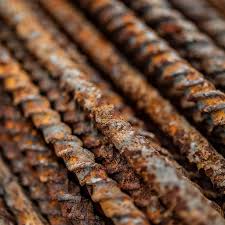
So, why this reluctance with new Rebars?
The world has already embraced the fact that rust doesn’t always mean poor quality. Yet, we are still stuck in the conservative mindset, hesitant to accept this reality.
Therefore, “Reddish does not always mean rust, and rust does not always mean bad Rebars.”
References:
- http://resources.crsi.org/index.cfm/_api/render/file/?method=inline&fileID=2A3DB5C2-BFAB-1923-893843A83B160B4E
- https://link.springer.com/article/10.1007/BF02829078