
In Search of Recovery from Contraction: Bangladeshs Rebar Market—How Will 2027 Go?
Bangladeshs Rebar Market
Bangladeshs Rebar MarketBangladeshs Rebar MarketBangladeshs Rebar MarketBangladeshs Rebar MarketBangladeshs Rebar MarketBangladeshs Rebar MarketBangladeshs Rebar MarketBangladeshs Rebar MarketBangladeshs Rebar MarketBangladeshs Rebar MarketBangladeshs Rebar MarketBangladeshs Rebar MarketBangladeshs Rebar MarketBangladeshs Rebar MarketBangladeshs Rebar Market
Bangladesh’s rebar industry is one of the most important components of the country’s construction and infrastructure sector. Demand for rebar is directly linked to construction activity in housing, commercial buildings, bridges, roads, power plants, and government development projects. However, over the past few years, this important industry has had to confront market contraction, political uncertainty, slower investment, high production costs, and financial pressure all at once
An analysis of historical market sales data shows that although annual rebar sales once exceeded 63 lakh tons, the market has declined to approximately 55 lakh tons in a recent fiscal year. The question is whether this decline signals a long-term downturn or whether the market can recover if economic and political conditions improve.
Engr. Mohammad Golam Hossan Farhan
The Market Over the Past Few Years: From Growth to Contraction
According to the market data collected, rebar sales in Bangladesh consistently remained above 60 lakh tons at one point. However, the trend has changed in recent years.
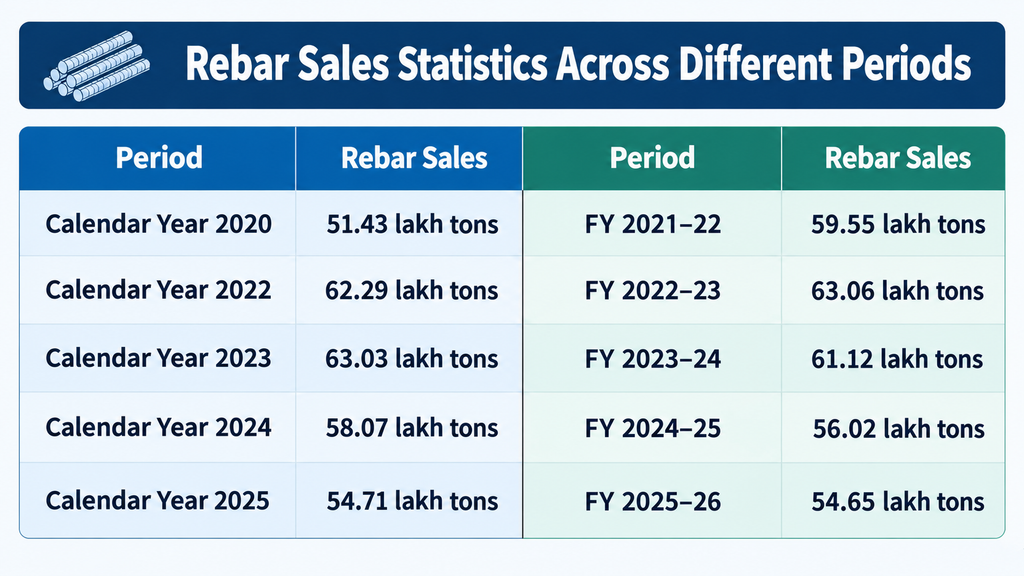
The most important aspect of these figures is the market’s recent decline. Sales were approximately 63.06 lakh tons in FY 2022–23. By FY 2025–26, they had fallen to approximately 54.65 lakh tons. In other words, sales declined by around 8.40 lakh tons over three fiscal years, equivalent to a contraction of approximately 13.3%.
Another notable point is that in FY 2024–25, sales fell by approximately 8.4% compared with the previous fiscal year. In FY 2025–26, the rate of decline slowed to approximately 2.4%. This may indicate that the deterioration of the market is slowing, but it cannot yet be called a confirmed recovery.
Political Instability: An Important Context Behind Market Contraction
The political changes of 2024 cannot be overlooked when analyzing Bangladesh’s rebar market. On August 5, 2024, the government led by then Prime Minister Sheikh Hasina fell amid the student–public movement. On August 8, an interim government led by Dr. Muhammad Yunus assumed responsibility. Political and administrative uncertainty arose before and after this change, affecting business, trade, and construction activities.
However, political instability cannot be identified as the sole cause of market contraction. High interest rates, difficult loan conditions, rising construction costs, weak private investment, and pressure on buyers’ purchasing power are also important factors. Political changes added further pressure to these existing problems—this is the comparatively balanced explanation.
Following the national election in February 2026, the elected government took office under Prime Minister Tarique Rahman, creating expectations of a return to market stability. However, the extent to which political change will have a positive impact in practice depends on how quickly project implementation, investment, financing, and business confidence return to normal.
Economic Pressure and the Impact of Production Costs
Even when demand in the rebar market declines, producers’ costs do not fall at the same rate. Scrap, billets, electricity, gas, transportation, port charges, and financing account for a large share of production costs. When these expenses rise while sales volumes remain low, maintaining profit per ton becomes difficult.
In a report published in June 2026, industry stakeholders said production costs had increased due to pressure from electricity, transportation, and other expenses. At the same time, weak demand had caused many mills to operate at less than half their installed capacity. This further increases the fixed-cost burden per ton. Many small mills have even shut down.
This situation creates two-sided pressure in the market. On one hand, producers may need to lower prices to increase sales; on the other, rising production costs mean that reducing prices increases the risk of losses. Therefore, an increase in market prices alone does not prove that the industry’s financial condition has improved. Sales volume, production costs, and profit margins must also be considered.
July–September 2026: What Do Recent Deliveries Indicate?
Monthly delivery data collected from eight major producers for the first quarter of 2026 help explain the market’s recent direction.
Combined deliveries by these eight companies rose from approximately 2.39 lakh tons in July to 3.02 lakh tons in August and 3.33 lakh tons in September. Combined deliveries increased by approximately 39.1% between July and September.
However, an increase in monthly deliveries does not mean the national market grew at the same rate. Deliveries may rise in a particular month because of orders for major projects, shipments held over from the previous month, inventory rebuilding, or changes in supply schedules. Moreover, October to March is considered the sales season for construction materials. In that sense, the figures for August and September suggest that the market is gradually approaching the stronger season. On the other hand, if sales by producers outside these eight companies decrease, overall national market growth could be comparatively lower.
Therefore, these figures may be viewed as a possible sign of some momentum returning to the market, rather than evidence of a confirmed recovery.
Estimated Size of the National Market: An Important Caution
The combined deliveries of the eight major producers over three months were approximately 8.74 lakh tons. To determine the size of the national market, sales by other producers must also be added.
Assuming combined sales by other producers during July–September 2026 were approximately 3.07 lakh tons, the national market for the first quarter comes to approximately 11.81 lakh tons. According to this calculation, the market is nearly stable compared with approximately 11.81 lakh tons in the corresponding quarter of FY 2025–26.
Production Capacity Versus Actual Demand
The gap between production capacity and actual sales is another important issue in Bangladesh’s rebar industry. New investment and the addition of modern technology may increase supply over the long term. But if market demand does not increase at the same rate, excess capacity could intensify competition among producers.
According to the capacity-related information provided, the combined annual capacity of two major producers is approximately 54 lakh tons. This is close to the potential national market of 55 lakh tons. Meanwhile, another major industrial group is entering the market with an annual production capacity of approximately 20 lakh tons. Among the more than 30 rebar producers currently operating in the market, just three companies will have the capacity to supply 74 lakh tons of rebar, while the expected total national market is only 55–56 lakh tons. This indicates the scale of competition that rebar producers may face in the near future. Under such intense competition, many more rebar producers could disappear from the market. Some producers may also decide to operate jointly in order to survive.
Therefore, future competition will depend not only on how much production capacity each company has, but also on production costs, quality control, product reliability, distribution networks, project-based supply, and customer service.
Market Forecast for 2027
past three fiscal years, a market of approximately 55 lakh tons for FY 2026–27 and approximately 56 lakh tons for calendar year 2027 can be regarded as a possible base-case scenario.
This is not a government forecast; it is an analytical estimate based on available information. The market’s potential trajectory may be considered under three scenarios:
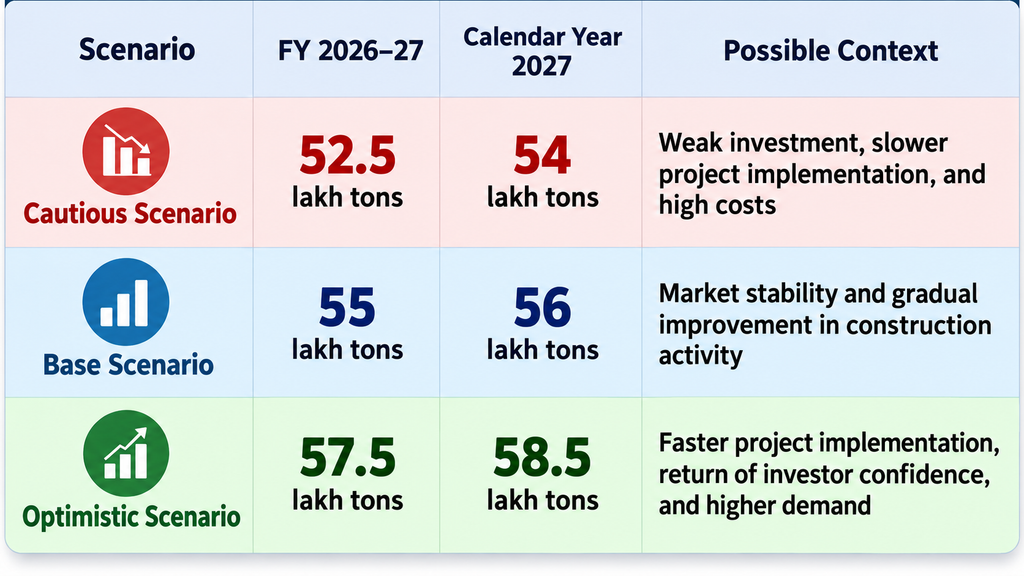
These figures are models of possible scenarios, not guaranteed outcomes. For the base-case scenario to materialize, effective implementation of government projects, momentum in private housing and commercial construction, improved financing, and political stability will be necessary.
Conclusion: Recovery Is Possible, but Conditional
Data from Bangladesh’s rebar market over the past few years clearly show that the industry has undergone significant contraction. The decline from approximately 63.06 lakh tons of sales in FY 2022–23 to around 54.65 lakh tons in FY 2025–26 illustrates the extent of pressure on the market. Political changes and delays in project implementation have intensified this pressure; high production costs, financing constraints, and weak construction demand have also played important roles. The IMF and World Bank forecast that Bangladesh’s GDP growth in FY 2026–27 will be 3.2% to 3.4%; concern about this low GDP growth is another major issue for us.
Although deliveries during July–September 2026 offer some positive indications, a market size of 55–56 lakh tons for 2027 may be regarded as a realistic base-case estimate of actual national market growth. However, it will depend on a recovery in the economy, investment, and construction activity.
Can Bangladesh restore investor confidence, political stability, GDP growth, momentum in local and national infrastructure development projects, and above all a business-friendly environment to revive the rebar market once again?