
Let the foundation of your structure be earthquake-resistant.
foundation of your structure be earthquakefoundation of your structure be earthquakefoundation of your structure be earthquakefoundation of your structure be earthquakefoundation of your structure be earthquakefoundation of your structure be earthquakefoundation of your structure be earthquakefoundation of your structure be earthquakefoundation of your structure be earthquake
Engr. Mohammad Golam Hossan Farhan
I have always seen Dhaka as a city of contradictions—on one side, a massive flow of people, and on the other, an unusual scarcity of land. The sky above is the same everywhere, yet the story beneath the ground changes from one corner of the city to another.
Dhaka—South Asia’s fastest-growing megacity.According to The Daily Star, nearly 36.6 million people live within just 306 square kilometers. The population density is more than 50,000 people per square kilometer, making it one of the most densely populated cities in the world.
The consequence:
Land has shrunk, skyscrapers have multiplied, and the city continues to expand over weak soil made of filled-up rivers, canals, wetlands, and lowlands.But how do we build sustainable structures on this weak soil in an earthquake-prone country like Bangladesh?The simplest answer: a strong foundation.
The Most Common Foundation Mistakes in Dhaka
1. Incorrect or Incomplete Soil Tests
Often, bore logs, SPT N-values, groundwater levels, or soil classifications are not accurate.Many assume that if a neighboring plot can support an 8–10 story building, theirs can too—a dangerous assumption.
Renowned seismologist Charles Richter once said:
“Buildings don’t kill people, weak foundations do.”
2. Reluctance to Use Combined Footings in Shallow Foundations
To reduce cost, many builders avoid combined footings and do not properly prepare the soil bed.
3. Errors in Cast-in-Situ Pile Execution
Incorrect casing, improper boring methods, voids during concreting—mistakes driven by operator dependency are seen frequently.These three mistakes not only keep the foundation weak but also make it highly vulnerable during earthquakes.But there is another critical factor we continue to ignore: soil liquefaction.
Liquefaction: Dhaka’s Hidden Danger Beneath the Ground
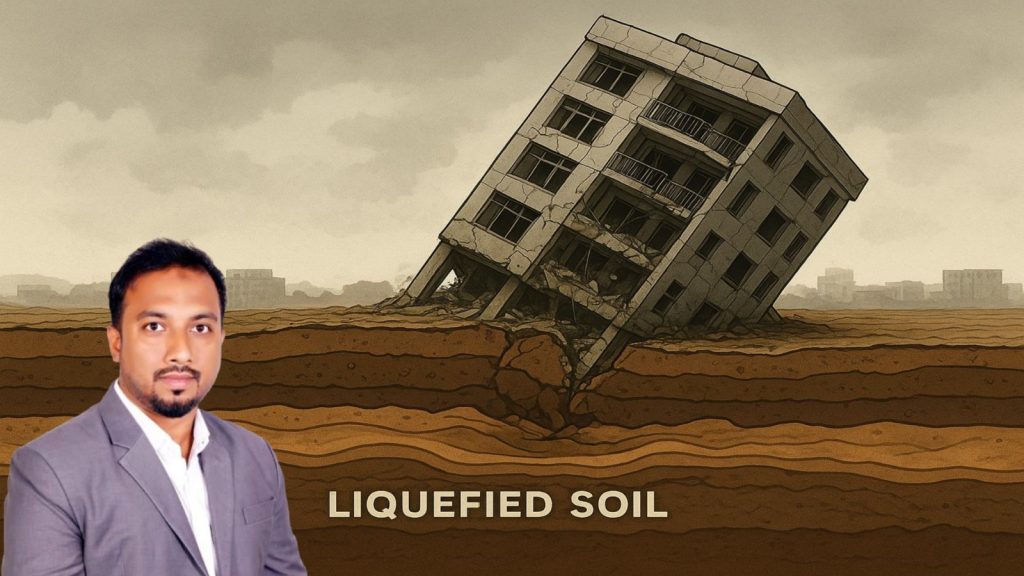
Most areas around Dhaka have been filled with soil, garbage, sand, sludge, water deposits, and waste materials over decades.This filled-up soil may seem stable but can liquefy during an earthquake, causing soil grains to separate and reducing the bearing capacity to almost zero.
As a result of potential liquefaction:
- Foundation soil may settle abruptly
- Piles may lose their stability
- Structures may tilt or collapse
This is why engineers are increasingly concerned about the ground underneath Dhaka’s buildings.
Pile Base Grouting: A Modern and Reliable Method to Strengthen Soil
Pile base grouting is an advanced engineering technique where high-pressure and high-volume cement-based grout is injected at the bottom of the pile. This process densifies, strengthens, and stabilizes the soil beneath the pile.
What Does Pile Base Grouting Achieve?
- Significantly increases soil density below the pile
- Dramatically enhances pile bearing capacity
- Reduces or prevents liquefaction
- Minimizes settlement and ensures long-term stability
- Provides extra safety even when piling has minor imperfections
Countries like Japan, Singapore, Dubai, Qatar, and many major European nations have been using this technology for years.
In Bangladesh, major national infrastructure projects such as the Metro Rail, Padma Rail Link, and port development projects have successfully applied pile base grouting.
Why Is Pile Base Grouting Even More Critical for Dhaka?
1. Half of Dhaka Is Built on Filled-Up Soil
RAJUK data shows that over a hundred canals, wetlands, and lowlands around Dhaka were filled between 1980 and 2020.
These soils fall under the highest liquefaction risk category.
Even if the foundation is strong, the layers below may fail.
2. High-Rise Buildings Are Growing Rapidly
Where 6–8 story buildings were once standard, now 18–25 story structures are common, and in many areas 30+ story towers are rising.
Higher buildings mean dramatically higher loads—so the foundation must be stronger and more stable than ever before.
3. The Most Reliable Way to Increase Pile Capacity
Pile base grouting can:
- Increase end-bearing capacity by 30–60%
- Reduce total settlement by up to 40%
- Ensure safe and stable foundations even on weak or filled-up soils
This is not a luxury—it is a necessity for Dhaka’s soil conditions and construction trends.
A Strong Foundation Is the Key to Structural Safety
Legendary structural engineer Ralph B. Peck famously said:
“An engineer is only as good as his foundation.”
No matter how modern the materials are, if the foundation is weak, the entire structure remains at risk.
A strong foundation means stability, safety, and long-term reliability.
Ensure a Safe Foundation for the Future of Dhaka
Every day Dhaka is rising higher—
high-rises, ultra-high-rises, and massive new developments.
Yet much of the city stands on filled-up soil that carries a significant liquefaction risk.
In this reality, strengthening foundations is not optional—it is absolutely essential.
Therefore—
✔ Conduct precise and accurate soil tests
✔ Ensure high-quality pile execution
✔ And most importantly—perform pile base grouting
Pile base grouting multiplies foundation strength, reduces settlement, and provides reliable safety even on weak soil.
Remember—
If the foundation is strong today, your structure will stand firm tomorrow—even in an earthquake. A safe foundation means a safe future.